Many small and medium-sized enterprises find themselves adapting their unique workflows to the constraints of standard software-as-a-service (SaaS) platforms. Most SaaS products offer robust features, but they come with an inherent compromise: a one-size-fits-all approach. That leaves businesses either bending their processes to fit the limitations of the platform, or paying hefty fees for modifications — and either way, the result is unnecessary expense and inefficiency.
AI-assisted software development is shifting that paradigm, especially for SMEs. It puts hyper-personalised software — systems tailored precisely to the way your business actually works — within reach at a fraction of the traditional cost.
That is a big claim, and "AI changes everything" has become the least reliable sentence in business technology. So this post sets out, as plainly as we can, what AI-assisted development genuinely changes about the economics of bespoke software, what it does not change at all, and how to judge whether the shift matters for your business.
The suit analogy
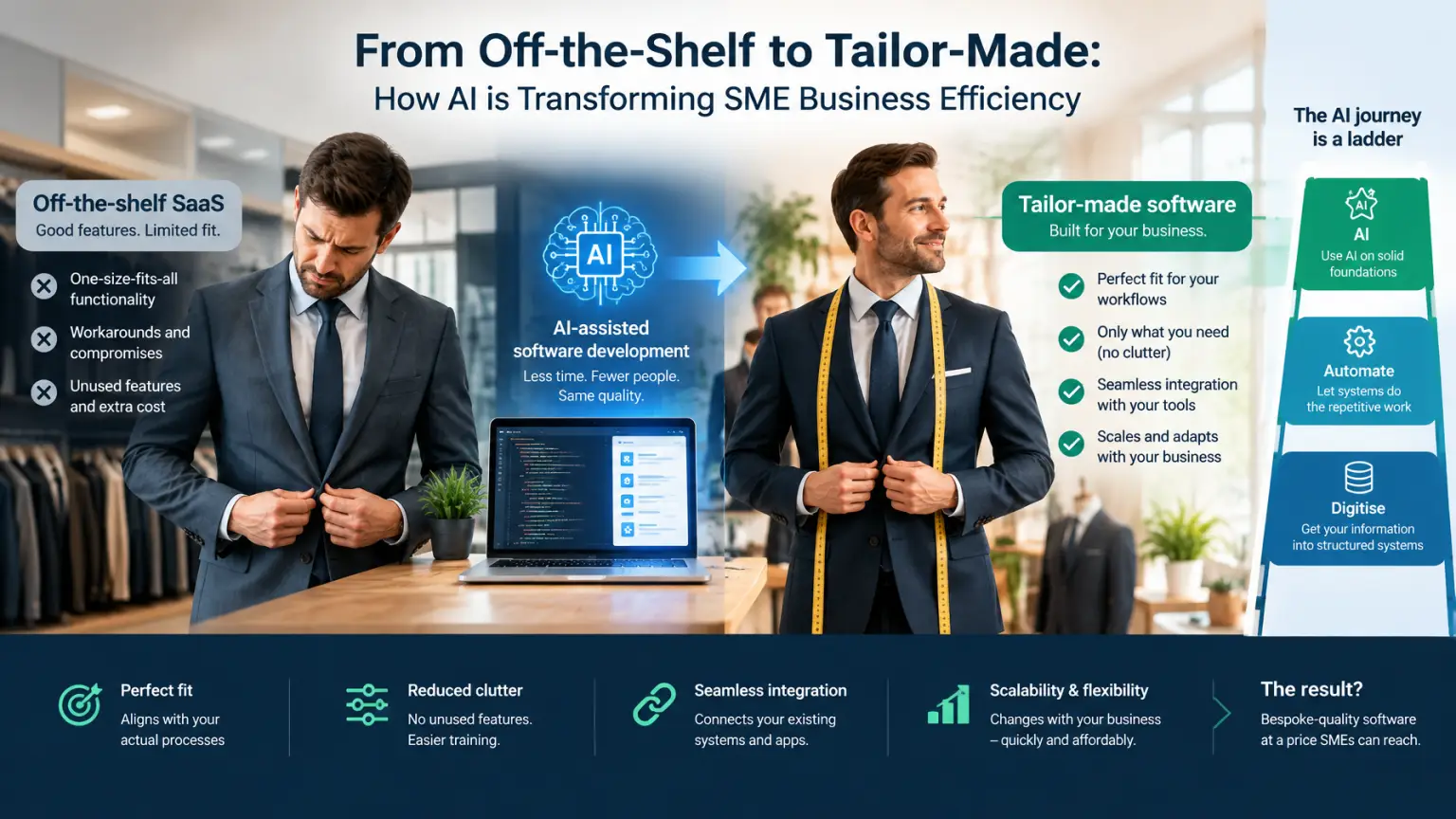
Consider buying a suit. Off the shelf from a high-street retailer, you may find something reasonably suitable in terms of fit, colour and fabric. But it will rarely match the impeccable fit, precise style and personal choice of cloth you would enjoy with a bespoke suit cut by a Savile Row tailor. The tailored version costs several times as much — which is why most of us settle for the high street.
AI-assisted bespoke software changes the price tag on the tailored option. It gives SMEs a realistic route to the software equivalent of that Savile Row experience at something much closer to a high-street price. And the fit is the whole point: software that matches your workflow exactly, rather than a product you have to squeeze your business into.
What AI-assisted development actually changes
Between them, the founders have been building bespoke business systems for over 30 years. The shape of a project has barely changed in all that time: understand the workflow, design the data model, build the system, test it, then refine it with the people who use it every day. What AI tooling changes is the cost of the middle of that process.
A large share of any development project is work that is skilled but repetitive: setting up data structures, writing the routine code that moves information between screen and database, drafting the first version of a report or a form, writing test cases. Modern AI coding tools produce good first drafts of exactly this kind of work in minutes rather than days. A senior engineer then reviews, corrects and integrates that work — the judgement stays human, but a great deal of the typing disappears.
The effect on a project budget is real. Work that used to justify a sizeable team now suits a small senior team working with AI tooling, and a small senior team carries far lower overheads. The saving is not a marketing invention; it comes from fewer hours, spent by fewer people, on the mechanical part of the job.
What it does not change
Honesty matters more than enthusiasm here, so it is worth being equally clear about what AI-assisted development does not do.
It does not remove the need for analysis. The hard part of a bespoke system was never the typing; it is understanding what the business actually does — where the exceptions live, which steps genuinely matter, and what the data has to look like for the answers to be trustworthy. An AI tool given a vague brief will produce plausible-looking software that solves the wrong problem, very quickly. Someone still has to do the thinking, and that someone should have seen a lot of business systems.
It does not remove the need for testing and accountability. Code produced quickly still has to be correct, secure and maintainable, and a named engineer still has to stand behind it. If anything, faster production makes disciplined review more important, not less.
And it does not make bespoke software cheaper than a basic monthly subscription. A tailored system is still an investment that has to earn its keep. What has changed is the gap: the premium for "built around your business" has narrowed to the point where the comparison is worth doing for far more SMEs than before.
The advantages of a tailored system
The advantages of bespoke software extend well beyond the initial cost question:
- Perfect fit. The system aligns exactly with your business processes, enhancing efficiency rather than forcing awkward workflow adaptations. Nobody has to remember that the notes field is really the delivery-instructions field because the product you bought has nowhere else to put them.
- Reduced clutter. Off-the-shelf products are built to satisfy everybody, so they carry features most businesses never touch. Removing what you do not need streamlines staff training and daily operations — a new starter learns one screen that matches the job, not a product manual.
- Seamless integration. A bespoke system connects with your existing systems and third-party applications in exactly the manner needed, improving productivity and data accuracy instead of leaving staff retyping the same information into three different places.
- Scalability and flexibility. When your business changes, the system changes with it — quickly and affordably — rather than waiting on a vendor's roadmap or accepting a costly SaaS lock-in.
Where this sits on the ladder
We describe the journey to AI as a ladder with three rungs: Digitise, Automate, AI. First get your information out of spreadsheets and inboxes and into structured systems. Then let those systems do the repetitive work for you. Then — and only then — apply AI to data and processes that are solid enough to support it.
Bespoke software is the middle rung, and AI-assisted development is making that rung cheaper to climb. There is a pleasing circularity to this: AI is reducing the cost of the very systems a business needs in place before AI can help it operationally.
Our work for PizzaExpress illustrates what the middle rung looks like in practice. We built the secure web portal that manages their Live Playlist programme — live music booked at more than 30 restaurants every week — replacing a process previously run on emails and spreadsheets. That system went live in September 2017 and was built the traditional way, at traditional cost. The same shape of project today, delivered by a senior team using AI tooling, involves substantially fewer billable hours. That is the change in plain terms: projects of proven value, now with a lower cost of entry.
When off-the-shelf is still the right answer
A bespoke software company telling you bespoke is always the answer should worry you, so let us be specific about when it is not.
If your process is genuinely standard — you invoice the way everyone invoices, your sales pipeline looks like every other pipeline — a mature SaaS product, configured well, will serve you at low cost, and we would tell you so. Accounting is the classic case: products like Xero and QuickBooks exist because the rules of accounting are the same for everyone, and paying to rebuild them would be a waste of your money.
The bespoke conversation starts where your competitive advantage lives: the workflow that is genuinely yours, the one you have bent three different products around and still end up managing with spreadsheets on the side. Standard tools for standard processes; tailored systems for the process that makes you different.
There is also a middle path worth naming, because it is often the right one: keep the off-the-shelf products you already rely on, and build the small piece of tailored software that connects them or fills the gap between them. Some of the most valuable systems we deliver are not replacements for anything — they are the missing piece that lets a business keep the tools its staff already know while removing the retyping and the workarounds that have grown up around them.
A concrete scenario
Picture a distribution business of a couple of dozen staff. Orders arrive by email and phone. Quoting requires stock levels, supplier lead times and customer-specific pricing, and the "system" is four spreadsheets plus the memory of two long-serving employees. Off-the-shelf CRMs have never fitted, because quoting is the business — and no generic pipeline understands price breaks that depend on supplier lead times.
A few years ago, a tailored quoting and order system for that business was often hard to justify at the price. With AI-assisted delivery, the analysis is the same and the data model is the same, but the build cost has fallen far enough that the payback arithmetic — hours saved, errors avoided, quotes out the same day — starts to work for much smaller companies. That is the quiet, practical meaning of the transformation in this post's title. Not robots running the warehouse: sensible software, finally at a price that fits the size of business that needs it.
What this means
In essence, AI-assisted bespoke development brings SMEs the kind of tailored, bespoke-quality software that would previously have been cost-prohibitive — and in doing so it challenges the assumption that the default answer for a growing SME is yet another subscription. It is a strategic shift towards precision, efficiency and adaptability: systems that fit the business, rather than businesses reshaped to fit their systems.
If you are weighing a decision like this — renewing a SaaS contract that has never quite fitted, or wondering whether the workflow you run on spreadsheets deserves better — the comparison now deserves fresh numbers. We are happy to talk it through honestly, including the cases where off-the-shelf remains the right call. And if you want to know where your business stands on the ladder first, our AI readiness assessment takes about two minutes and will tell you which rung to start from.